From Intent to Economic Value.
The expansion of Artificial Intelligence presents unprecedented possibilities, yet capturing its true financial value remains a challenge. This is a strategic invitation to analyze the nexus between orchestration, agentic governance, and structural impact on your bottom line.
Intelligence Engineering
Adoption vs. Tangible Value
72%
Organizations actively using AI in at least one business unit. The technology has become the corporate core. Source: McKinsey Global AI.
50%
Projected growth in internal AI access for 2025: shifting from proofs of concept to live production. Source: Deloitte AI Enterprise.
~15%
Only a fraction of enterprises report a direct link between AI adoption and actual profitability. Source: Forrester Research.
20–30%
Tangible, structural efficiency gains in corporations deploying systemic—rather than siloed—AI solutions. Source: McKinsey Studies.
Domain Perspectives
The Pillars of Agentic Intelligence Engineering
Diagnostic Engineering Protocol
PED — The Forensic Audit. Unlike declarative diagnostics, the PED is an engineering instrument that mathematically measures Operational Drift — the money lost in the gap between AI strategy and actual execution. Based on strict documentary evidence, it evaluates your company's Institutional Capacity, separating those operating in the rearview mirror (Data-Driven) from those ready for profitable autonomy (Frontier Firm).
Intent to Value Protocol
I2V — The Execution Architecture. We don't just deliver a methodology; we deliver an Architecture. I2V is the mechanism that designs and executes the technical solution to eliminate Drift. It encodes the strategy into Value Trees and implements Autonomous Agents and Guardrails in runtime. It is the engineering that takes causality off the paper and installs it in the heart of your P&L.
Why this duo works: The Yin-Yang of Causal Engineering
Most organizations confuse two different things: discovering the problem and building the mechanism that eliminates it.
Arcogi rigorously separates these two dimensions.
1. PED — The Forensic Medical Examiner / Causal Auditor
(Structural Diagnosis)
The PED doesn't “opine”. It measures.
It identifies where Operational Drift is occurring, why it happens, and the economic cost of the invisible friction between strategy and execution.
The PED acts as an organizational forensic examiner: it examines evidence, tracks decisions, measures misalignments, and quantifies structural loss.
It doesn't suggest “best practices”. It reveals where the architecture is failing.
Result: mathematical clarity on the problem.
2. I2V — The Architect / Causal Engineer
(Architecture & Runtime Execution)
I2V does not describe solutions. It designs and installs mechanisms.
If PED reveals where value is leaking, I2V builds the structure that eliminates the leak.
It encodes strategy into Value Trees, transforms decisions into operable units, installs Autonomous Agents with explicit boundaries, implements risk-proportional Guardrails, and connects execution to runtime causal telemetry.
I2V doesn't deliver a static framework. It delivers a decision-making operating system.
Result: economic causality installed in the real flow of the business.
The Formula 1 Value Logic
Winning on the track isn't just about speed. It's the byproduct of a deep causal chain involving precision engineering, real-time telemetry, and flawlessly governed execution.
I. Strategic Engineering
Before the race, the car is engineered using rigorous simulations and historical data. Our diagnostic protocol (PED) formalizes your economic intent, maps the causal chain, and pinpoints critical P&L variables. This lays the groundwork upon which your entire operational architecture will be built.
II. Operational Architecture
In Formula 1, peak performance stems from applied engineering. Our I2V architecture translates pure intent into an executable system: building robust agent logic, integrating data pipelines, and deploying telemetry to operate and adapt in real time. Intent drives decisions; decisions generate evidence.
III. Disciplined Execution
Every race introduces unpredictable variables. Our agents operate with graduated autonomy and strict guardrails. Adjustments are driven by hard evidence, never improvisation. Sustaining high performance under uncertainty demands absolute architectural control.
IV. Sustained Value
Championships are won through consistency and compounding advantages. The journey of organizational evolution is about the continuous compounding of P&L value, fueled by iterative cycles of ruthless diagnosis, robust architecture, and disciplined execution.
The Challenge of Isolated Metrics
Price Optimization
Aggressive tactics increased initial revenue but generated subsequent margin erosion due to associated costs.
The model integrates predictive analysis focusing on sustainable improvement of the global margin, respecting market friction.
Retention Models
Reductions in churn rates were noted, but incentive costs did not pay off compared to customer value.
Advanced retention logic proposes budget balancing of incentives in favor of the account's lifetime value.
Inventory Turnover
Policies focused exclusively on filling stockouts resulted in undesirable tied-up capital.
The orchestrated network approach favors an optimal level between idle capital, yard costs, and demand support.
Foundations of Our Epistemology
"You can't manage what you can't measure, and you can't measure what you can't manage."
"Curiosity is not a line, but a network; it leads us to ask why a relationship exists, not just that it exists."
"Technology doesn't alter realities just by its presence; it alters realities when its consequences are intentional and reflective."
"Information is what reduces uncertainty; knowledge is what empowers action."
Boundaries of Applicability
Recent Perspectives
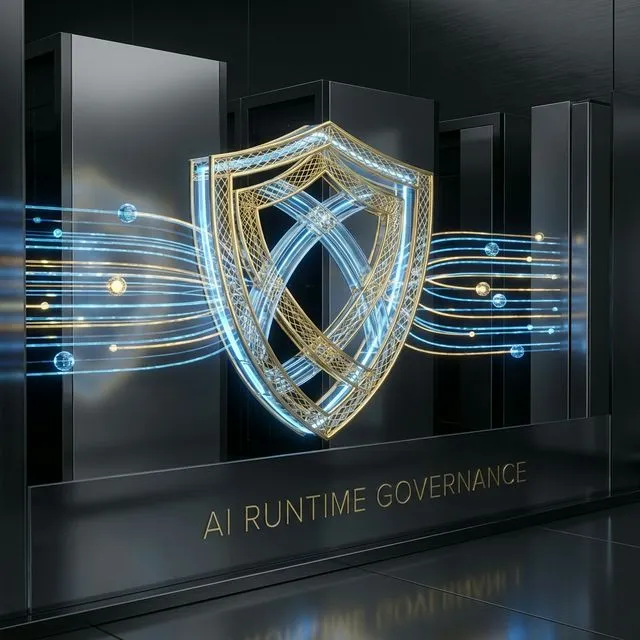
Runtime Governance: How to Control Agent Autonomy and Avoid Recklessness in AI-First Environments
Managing intelligent systems' autonomy in real-time is the biggest strategic challenge of 2026. Learn how to migrate from static control to runtime governance.
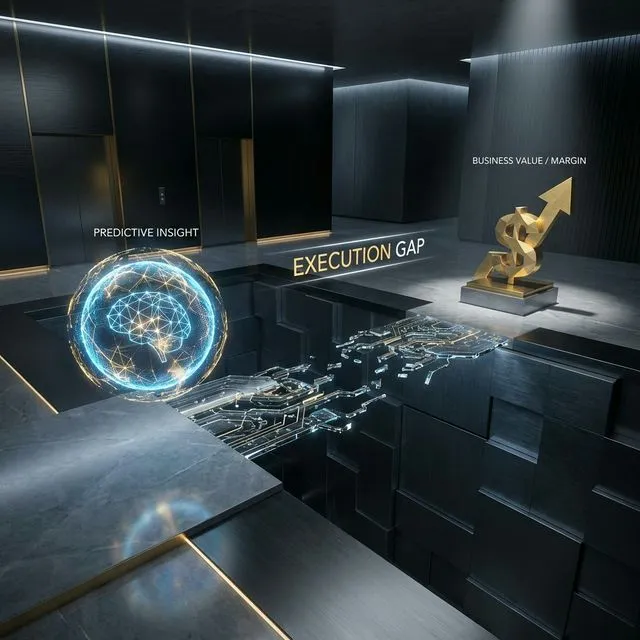
The Prediction Trap in 2026: Why Knowing the Future Doesn't Protect Your Margin with AI
Predicting with AI is no longer a competitive advantage: it's just the starting point. Bridge the Execution Gap and capture real business value.
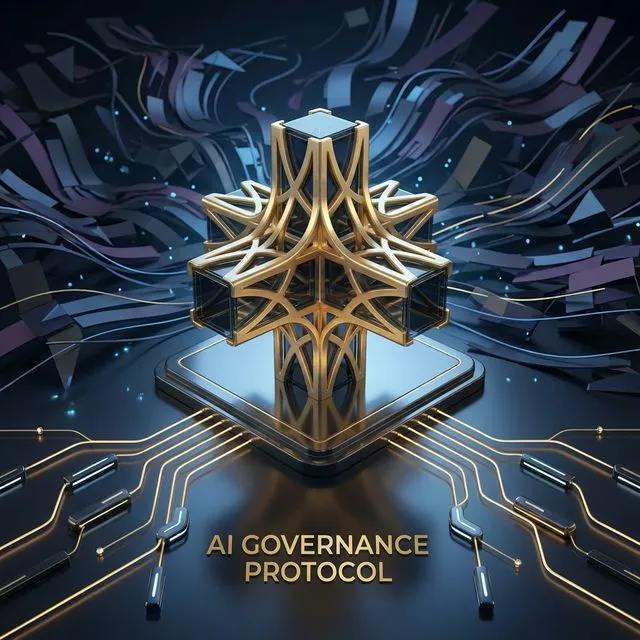
From Governance to Authority: Structuring AI Decisions That Truly Matter in 2026
In 2026, organizational competitiveness lies in governance structures. Learn how protocols connect AI to reliable, measurable business outcomes.
Board-Level Discussion Topics

Agente Arco
Manifesto Assistant